Meta description: Compare the debt snowball and debt avalanche with a worked example and real numbers, plus consolidation, balance transfers, and where to get help in the US, Canada, and Germany.
Paying off several debts at once can feel like walking up a descending escalator. You make payments every month, yet balances barely move because interest keeps pulling them back. The cure is not working harder. It is having a plan.
Two plans dominate personal finance conversations: the debt avalanche and the debt snowball. Both can get you to zero. They differ in what they optimize. One optimizes for math, the other for motivation. This guide compares them with a worked example so you can choose with confidence.
Before You Choose a Method: Four Preparations
A payoff strategy only works on a solid base.
1. List every debt. Write down the lender, current balance, interest rate (APR), and minimum monthly payment for each. Include credit cards, personal loans, car loans, student loans, and any overdraft balance.
2. Find your total monthly debt budget. Add all your minimum payments, then decide how much extra you can put toward debt each month. Even a small extra amount makes a big difference over time.
3. Stop adding new debt. If you keep charging new purchases to the cards you are paying off, no method will work. Consider switching to debit or cash while you pay down balances.
4. Build a small safety buffer. Hold at least one month of essential expenses in savings. Without it, any surprise bill goes right back onto a card and erases your progress.
The Debt Avalanche Method
How it works:
- Pay the minimum on every debt.
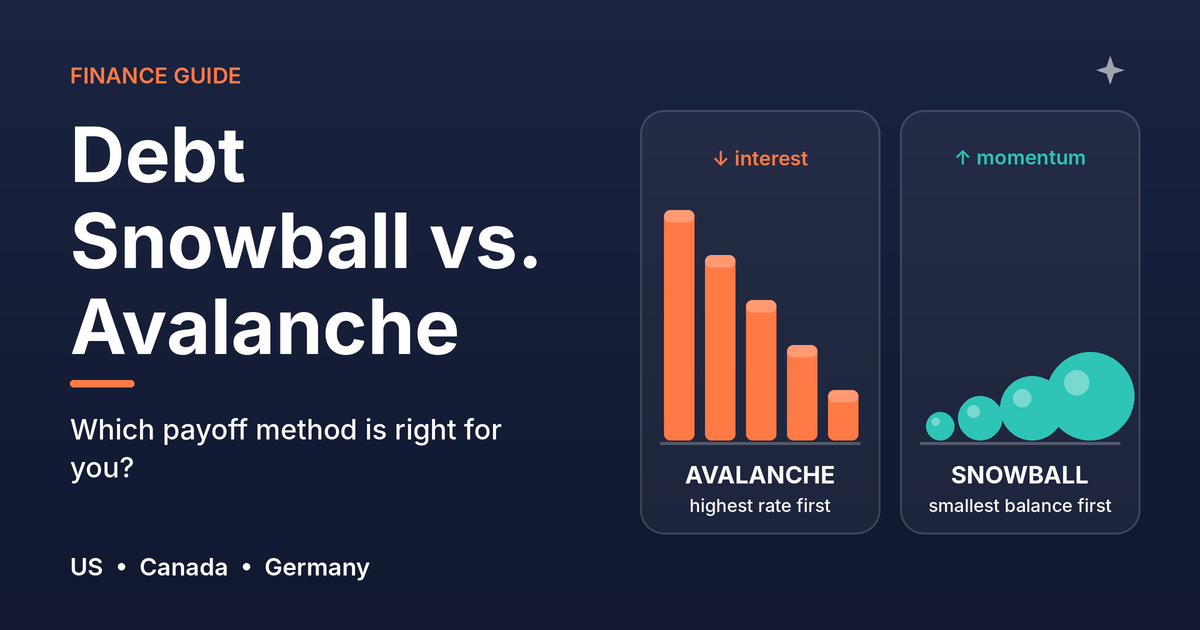
- Put every extra dollar toward the debt with the highest interest rate.
- When that debt is gone, add its entire payment to the debt with the next highest rate.
- Repeat until you are debt-free.
The strength: The avalanche is mathematically optimal. By attacking the most expensive debt first, you reduce total interest paid and usually finish sooner.
The weakness: If your highest-rate debt also has a large balance, you may go many months without eliminating a single account. For some people, the lack of visible progress is demoralizing, and demotivation is the main reason payoff plans fail.
The Debt Snowball Method
How it works:
- Pay the minimum on every debt.
- Put every extra dollar toward the debt with the smallest balance, regardless of interest rate.
- When it is paid off, roll that payment into the next smallest balance.
- Repeat until finished.
The strength: Fast, visible wins. Closing an account feels good, and behavioral research suggests that early success helps people stay committed. Each cleared debt also frees up cash flow, which makes the “snowball” grow.
The weakness: Because it ignores interest rates, you will usually pay more total interest than with the avalanche, and it may take slightly longer to finish.
A Worked Example With Real Numbers
Let’s compare both methods using the same facts. Suppose you have three debts and can afford 400 per month in total toward debt:
| Debt | Balance | Interest rate (APR) | Minimum payment |
|---|---|---|---|
| Credit card A | 1,500 | 22% | 40 |
| Credit card B | 6,000 | 25% | 150 |
| Personal loan | 3,500 | 9% | 80 |
Your minimums total 270, so you have 130 extra each month. (The currency does not matter, so read these as dollars, Canadian dollars, or euros.)
If You Only Pay the Minimums
Assuming minimums stay fixed and no new debt is added, it would take roughly 87 months (over seven years) to clear everything, with about 8,850 paid in interest. That is the baseline to beat.
The Avalanche Approach
Extra money goes to Card B (25%), then Card A (22%), then the loan (9%).
- Total time to debt-free: about 37 months
- Total interest paid: about 3,420
- First debt eliminated: around month 29, which feels like a long wait
The Snowball Approach
Extra money goes to Card A (1,500) first, then the loan, then Card B.
- Total time to debt-free: about 39 months
- Total interest paid: about 4,220
- First debt eliminated: around month 10, a much faster win
What the Numbers Tell Us
| Method | Months to debt-free | Total interest | First account cleared |
|---|---|---|---|
| Minimums only | about 87 | about 8,850 | slowly |
| Avalanche | about 37 | about 3,420 | about month 29 |
| Snowball | about 39 | about 4,220 | about month 10 |
Both methods save a huge amount compared with paying minimums. The avalanche beats the snowball by roughly 800 in interest and two months. Whether that gap is worth losing an early win is a personal decision.
Notice something else: the gap between the two methods (about 800) is far smaller than the gap between any plan and no plan (about 5,000 or more). Having a plan matters more than which plan you pick.
(These figures come from a simplified monthly calculation and are illustrative. Real results vary with exact due dates, compounding rules, and changes in rates.)
Which Method Should You Choose?
Choose the avalanche if you:
- Are motivated by numbers and efficiency
- Have debts with very different interest rates
- Have a large high-rate balance that is costing a lot each month
- Have strong discipline and do not need frequent rewards
Choose the snowball if you:
- Have tried and failed to stick with a plan before
- Feel overwhelmed by the number of accounts
- Have debts with similar interest rates
- Want fast momentum and simplicity
Consider a hybrid if you:
- Begin with the snowball for the first one or two small debts to build confidence
- Then switch to the avalanche for the rest
- Or pay off any debt that has a particularly cruel rate (such as payday loans) first, whatever its size
A useful tiebreaker: if the interest-rate gap between your debts is large, favor the avalanche. If rates are close, the snowball costs little extra.
Tools That Can Make Payoff Faster
Balance Transfers (US and Canada)
Some credit cards offer a promotional rate (often 0%) for a limited period on transferred balances. This can save a lot of interest if you pay down the balance before the offer ends. Watch for transfer fees (often a few percent), what rate applies afterward, and the temptation to run the old card up again.
Debt Consolidation Loans
A consolidation loan replaces multiple debts with one loan at a lower fixed rate. It simplifies payments and can cut interest, but only if the new rate is genuinely lower and you do not take on new debt. Beware of longer terms that lower your monthly payment but increase total interest.
Refinancing in Germany
In Germany, a Dispokredit (overdraft) and credit card balances often carry high rates. A lower-rate installment loan (Ratenkredit) may help, but compare the effective annual rate (effektiver Jahreszins), fees, and early-repayment rules. Legal rights concerning early repayment exist but have conditions, so read your contract.
Negotiating With Lenders
Call your lender and ask about hardship programs, a lower rate, or a temporary reduction in payments. Many people never ask, and the answer is sometimes yes.
Increasing Your Income
Even a temporary side income, selling items you no longer need, or working extra hours can fund a faster payoff. Direct tax refunds and bonuses straight to debt.
Where to Get Help
If you feel overwhelmed, free or low-cost help is available:
- United States: Nonprofit credit counseling agencies (look for those accredited by recognized national organizations) can review your budget and may offer a debt management plan.
- Canada: Non-profit credit counselling agencies provide budgeting help and may negotiate with creditors.
- Germany: Schuldnerberatung centers, often run by charities or local governments, offer free or low-cost advice. For people who cannot repay, German law also provides a formal insolvency process (Verbraucherinsolvenz), which is a serious step to discuss with a qualified adviser.
Be careful with for-profit “debt relief” companies that charge large upfront fees or promise to erase debt. Legitimate counselors rarely promise miracles.
Practical Tips to Stay on Track
- Automate everything. Set up automatic minimum payments and a scheduled extra payment.
- Track progress visually. A chart on the fridge or a spreadsheet makes progress concrete.
- Redirect freed payments. When a debt is cleared, immediately add its payment to the next target. Do not let the money drift into everyday spending.
- Celebrate milestones cheaply. A home-cooked special dinner counts.
- Review every three months. Adjust the plan for rate changes, raises, or new expenses.
- Watch for “lifestyle creep.” When your income rises, direct a share of the raise to debt before you adapt to spending it.
Common Mistakes
Stopping all saving. Without a buffer, an emergency becomes new debt.
Ignoring minimum payments. Missing a minimum can bring late fees and credit damage, which defeats the purpose.
Closing paid-off cards impulsively. In the US and Canada, closing accounts can shorten credit history and affect your score. Consider keeping them open but unused, unless they carry fees.
Choosing the method by arguing online. The “best” method is the one you will follow for 30+ months. Pick the one that matches your personality.
Taking a new loan without calculating the total cost. Compare total interest and fees, not just the monthly payment.
Frequently Asked Questions
Is the avalanche always cheaper? Yes, in pure interest terms, assuming you follow it consistently. But if the snowball keeps you from quitting, it can be the cheaper choice in practice.
What if I have a student loan with a low rate? Low-rate loans are often last in an avalanche, and it can be reasonable to pay the minimum while you attack higher-rate debt, though specific benefits such as tax deductions or income-based plans may influence the decision.
Should I save or pay off debt first? Build a small starter buffer, then focus on high-interest debt, while keeping any employer retirement match if available.
The Bottom Line
The avalanche saves the most money. The snowball often keeps people going. In our example, the difference between them was about 800, while the difference between having a plan and not having one was around 5,000. Choose the method that fits how you behave, automate it, and keep going until the last balance hits zero.
This article is for general educational purposes and is not personalized financial advice. Calculations are simplified illustrations. If you are in serious financial difficulty, consider speaking with a qualified, non-profit counselor in your country.